

Quick answer: The clearest signs your natural hair needs a trim are single strand knots you can feel when running your fingers through your hair, split ends visible to the naked eye, ends that tangle immediately after detangling, and a see-through or thin appearance at the ends compared to the mid-shaft. Trimming 0.25-0.5 inches every 3-4 months prevents these issues from traveling up the hair shaft and causing bigger breakage. Skipping trims to “save length” usually costs you more length in the long run.
Sign 1: Single Strand Knots (Fairy Knots)
Last updated: June 15, 2026
Single strand knots are tiny knots that form on individual strands. They’re called fairy knots because they’re so small they look like a fairy tied them. On coily hair (especially 4B-4C), they’re extremely common because each strand curls back on itself tightly enough to form a literal knot.
How to check: Run your fingers slowly along a strand from root to tip. Single strand knots feel like tiny bumps or beads along the strand.
Why it matters: Each knot is a weak point where the strand will eventually break. The knot also catches on neighboring strands, creating tangles and pulling other hairs out during detangling.
What to do: You can’t untie single strand knots. The only fix is snipping each one off individually or trimming the ends where they’re concentrated.
Sign 2: Visible Split Ends
Split ends happen when the protective cuticle layer at the tip of a hair strand wears away, exposing the inner cortex, which then splits into two or more branches.
How to check: Take a small section of hair and look at the last inch under good lighting. Healthy ends are uniform thickness all the way down. Split ends look like tiny forks, trees, or frayed rope.
Why it matters: Splits travel. If you don’t remove a split end, it works its way up the shaft, sometimes 2-3 inches. What started as a minor trim need becomes a major cut.
Sign 3: Ends Tangle Immediately After Detangling
You just spent 30 minutes detangling. Two hours later, the ends are knotted again. This happens when the ends are so damaged that the rough, raised cuticles catch on each other constantly.
Healthy hair can go several days between detangling sessions without significant tangling. If your ends re-tangle within hours, those ends have lost their smooth cuticle layer and will only create more tangles (and more breakage during the next detangling session).
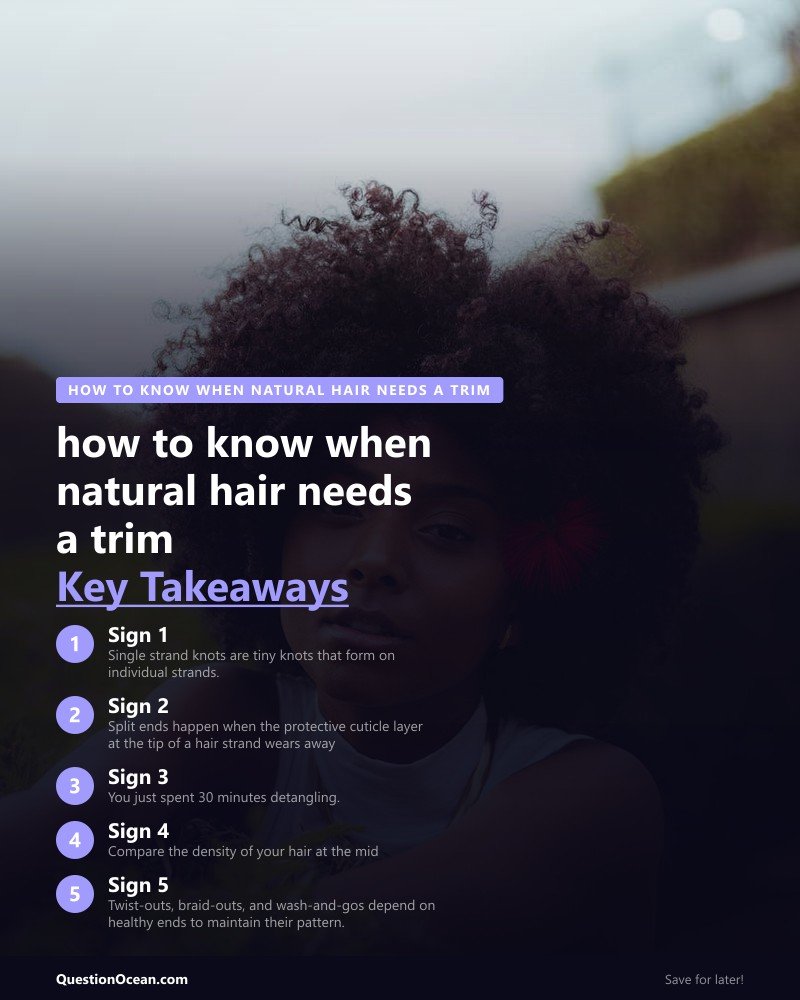
Sign 4: Ends Look See-Through or Thin
Compare the density of your hair at the mid-shaft (about ear level) to the density at the tips. If the ends are noticeably thinner, wispy, or see-through while the upper portion is full and dense, you’ve lost a lot of strands at the ends.
This happens when breakage removes individual strands at different points. Not every strand breaks at the same spot, so you end up with a tapered, thinning hemline instead of a blunt, full one.
The test: Gather your hair into a ponytail. If the ponytail is thick at the base and tapers to a very thin point at the bottom, the ends need attention.
Sign 5: Hair Won’t Hold Styles Anymore
Twist-outs, braid-outs, and wash-and-gos depend on healthy ends to maintain their pattern. When the ends are damaged, they frizz out, refuse to clump, and unravel from the style pattern. If your twist-outs used to last 5 days and now fall apart by day 2, the ends may be the problem.
Sign 6: Increased Breakage During Normal Handling
Some breakage during detangling is normal for natural hair, especially coily textures. But if you’re noticing significantly more hair on your comb, brush, or in the shower drain than usual, and the broken pieces are short (not full-length shed hairs), that’s breakage happening at weak points along the strand, often concentrated at the damaged ends.
Full-length shed hairs have a white bulb at one end (the root). Broken strands have no bulb and are shorter. If most of what you’re losing is broken strands, your ends need trimming.
Sign 7: Rough, Dry Texture at the Ends
Run your fingers from root to tip. Healthy hair feels relatively smooth (allowing for texture). Damaged ends feel rough, crunchy, or brittle, even after moisturizing. The cuticle is so far gone that no amount of conditioner can make those ends smooth again.
If the first 8 inches feel great and the last 2 inches feel like straw, those last 2 inches are holding back the health of the entire head.
Sign 8: Color Looks Different at the Ends
This applies to both dyed and natural hair. Damaged ends absorb and reflect light differently than healthy hair. On natural (undyed) hair, the ends may look lighter or duller than the roots and mid-shaft. On color-treated hair, damaged ends hold color differently, often appearing brassy, faded, or uneven.
Sign 9: You Can’t Remember Your Last Trim
If you genuinely can’t remember the last time you trimmed, it’s been too long. Even with perfect care, natural hair (especially Type 3-4) needs maintenance trims every 3-4 months. The ends of your hair are the oldest part, and they’ve endured the most manipulation, friction, heat, and environmental stress.
How Much to Trim
| Situation | Amount to Remove |
|---|---|
| Routine maintenance (no visible damage) | 0.25 inch (just the very tips) |
| Some split ends and single strand knots | 0.5 inch |
| Significant splits, tangles, thinning | 0.75-1 inch |
| Severe damage, splits traveling up the shaft | 1-2 inches (or until you’re cutting through healthy hair) |
How to tell you’ve cut enough: After trimming, the cut edge should look clean and uniform. If you can still see splits or roughness at the new hemline, you need to go a bit further.
How to Trim Natural Hair at Home
What you need: Sharp hair-cutting shears (not regular scissors, which crush the strand and create new splits), clips for sectioning, and a mirror.
Method for coily hair:
- Work on stretched hair (either blow-dried on low heat, banded, or twisted and air-dried). Trimming shrunken hair leads to uneven results because the shrinkage hides the actual length.
- Section the hair into 8-12 sections.
- Take one section, stretch it gently between your fingers.
- Cut straight across at the desired point.
- Release and move to the next section.
- After all sections are done, let hair shrink back and check for evenness.
Method for curly hair (Type 2-3):
- Wash and style as normal, let dry completely.
- Identify the ends that don’t curl properly, look wispy, or stick out.
- Cut individual curls at the natural curl boundary (where the curl ends and the frizzy tip begins).
- This is sometimes called “dusting” because you remove only the damaged dust at the tips.
Trim Schedule
| Hair Type | Recommended Trim Frequency | Amount per Trim |
|---|---|---|
| Type 2 (waves) | Every 8-12 weeks | 0.25-0.5 inch |
| Type 3 (curls) | Every 10-14 weeks | 0.25-0.5 inch |
| Type 4 (coils) | Every 12-16 weeks | 0.25-0.5 inch |
Type 4 hair can go slightly longer between trims because the tight coil pattern hides damage better and the ends are tucked away in protective styles more often.
The growth math: Hair grows about 0.5 inches per month, or roughly 1.5-2 inches per trim cycle. Trimming 0.5 inches means you’re netting 1-1.5 inches of length per cycle. Over a year, that’s 4-6 inches of net growth. Skip trims, and breakage from damaged ends can erase that same 4-6 inches.
Frequently Asked Questions
Q: How do I know when my natural hair needs a trim? A: The top signs are single strand knots, visible split ends, ends that tangle immediately after detangling, and a thin or see-through appearance at the tips. If you notice two or more of these, schedule a trim.
Q: Does trimming natural hair make it grow faster? A: No. Trimming has no effect on the growth rate from the follicle. What it does is prevent breakage from traveling up the shaft, which means you retain more of the growth you already get. The result looks like faster growth, but it’s actually better retention.
Q: Can I trim my own natural hair? A: Yes, for routine maintenance trims (0.25-0.5 inch). Use proper hair-cutting shears, work on stretched hair for accuracy, and cut in sections. For significant cuts or shape changes, go to a professional who specializes in natural hair.
Q: How often should I trim 4C hair? A: Every 12-16 weeks (3-4 months). Trim 0.25-0.5 inches based on the condition of the ends. If you have a strong protective styling routine that minimizes manipulation, you may be able to extend this to every 16-20 weeks.
Regular trimming feels counterproductive when you’re growing your hair out, but it’s one of the most reliable length-retention tools available. A small, consistent trim prevents the kind of damage that leads to a big, involuntary cut later.
For more on 4C length retention, see our 4C hair growth guide.