
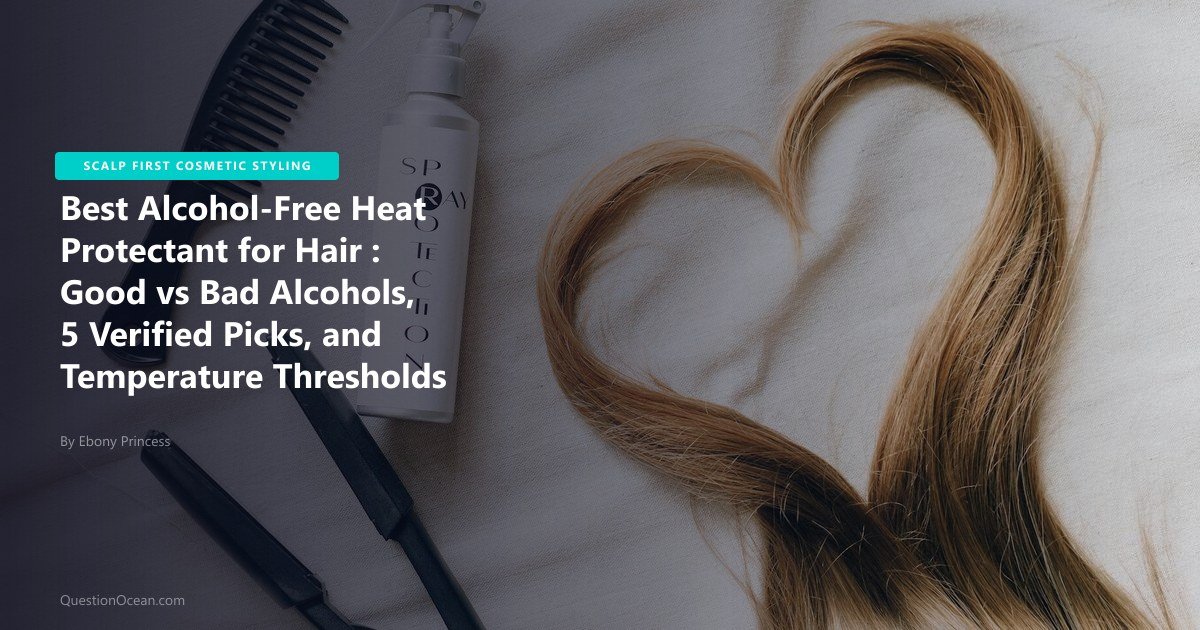
“Alcohol-free” heat protectant is the most misunderstood label in hair care: because there are two entirely different categories of alcohol in cosmetics, and only one is drying. Short-chain alcohols (ethanol, isopropyl alcohol, SD alcohol, denatured alcohol) evaporate fast and strip moisture from the hair, which is counterproductive in a heat protectant whose job is moisture retention, while long-chain fatty alcohols (cetyl alcohol, cetearyl alcohol, stearyl alcohol) are conditioning agents that HELP the hair and should NOT be avoided. When searching for an “alcohol-free” heat protectant, the goal is avoiding the short-chain drying alcohols while welcoming the long-chain fatty alcohols. The 5 picks below are verified free of all drying alcohols while containing the beneficial ones, and each protects hair up to its rated temperature threshold.
Good vs Bad Alcohols: The Complete Breakdown
Last updated: May 1, 2026
| Alcohol Type | Examples | Effect on Hair | Avoid? |
|---|---|---|---|
| Short-chain (BAD) | Ethanol, isopropyl alcohol, SD alcohol 40, denatured alcohol, alcohol denat. | Evaporates quickly, strips moisture, dries hair | YES |
| Long-chain fatty (GOOD) | Cetyl alcohol, cetearyl alcohol, stearyl alcohol, behenyl alcohol | Conditions, softens, adds slip | NO, these are beneficial |
| Aromatic (NEUTRAL) | Benzyl alcohol | Preservative, low concentration | Usually fine |
The ingredient list tells you which type is present. If “alcohol denat.” or “SD alcohol” or “isopropyl alcohol” appears in the first 5 ingredients, that’s a drying heat protectant. If “cetearyl alcohol” appears, that’s a conditioning agent.
Why Drying Alcohols Are Especially Bad in Heat Protectants
Heat protectants work by:
- Creating a barrier layer on the hair that insulates from direct heat
- Retaining moisture inside the hair shaft during high-temperature exposure
- Reducing friction during flat-iron or curling iron passes
Drying alcohols directly sabotage #2. They strip moisture from the hair BEFORE the heat even touches it. The result: the hair enters the styling tool already dehydrated, and the heat completes the damage.
Temperature Thresholds: How Much Heat Your Hair Can Handle
| Temperature | Risk Level | What Happens |
|---|---|---|
| Below 300°F (150°C) | Low | Minimal damage with heat protectant |
| 300-350°F (150-175°C) | Moderate | Cuticle starts lifting, moisture loss begins |
| 350-400°F (175-200°C) | High | Significant protein denaturation, cuticle damage |
| 400-450°F (200-230°C) | Very high | Keratin breakdown, permanent cuticle damage |
| Above 450°F (230°C) | Extreme | Hair can scorch, char, or break off |
First-degree hair damage (reversible with conditioning) starts at ~300°F. Permanent protein denaturation begins at ~400°F. No heat protectant can fully protect at 450°F+, it only reduces the damage.
The 5 Best Alcohol-Free Heat Protectants (2026)
All 5 verified free of drying short-chain alcohols as of 2026 formulations.
Pick 1, Chi 44 Iron Guard Thermal Protection Spray
Drying alcohol status: Free of all short-chain alcohols Protection up to: 450°F (232°C) Key ingredients: Silk amino acids, ceramic complex Texture: Lightweight mist, no residue Best for: Fine to medium hair, daily flat-ironing Price: $$ ($12-18)
Pick 2: Bumble and Bumble Hairdresser’s Invisible Oil Heat/UV Protective Primer
Drying alcohol status: Free of all short-chain alcohols Protection up to: 450°F (232°C) Key ingredients: 6-oil blend, vitamin E Texture: Light oil-mist, adds shine Best for: Dry, damaged, or color-treated hair Price: $$$ ($28-34)
Pick 3: Kenra Professional Platinum Blow-Dry Spray
Drying alcohol status: Free of all drying alcohols Protection up to: 428°F (220°C) Key ingredients: Keratin amino acids, panthenol Texture: Lightweight spray Best for: Blow-dry focused routines Price: $$ ($18-24)
Pick 4: Mielle Organics Mongongo Oil Thermal & Heat Protectant Spray
Drying alcohol status: Free of all short-chain alcohols Protection up to: 450°F (232°C) Key ingredients: Mongongo oil, baobab oil Texture: Light spray with natural oil base Best for: Natural and textured hair types 3-4 Price: $ ($10-14)
Pick 5 — Cantu Shea Butter Thermal Shield Heat Protectant
Drying alcohol status: Free of all drying alcohols Protection up to: 400°F (204°C) Key ingredients: Shea butter, argan oil Texture: Cream-spray Best for: Thick, coarse, or coily hair on a budget Price: $ ($6-10)
Alcohol Free Heat Protectant Spray
How to Apply Heat Protectant Correctly
Most people under-apply or apply unevenly. The correct method:
Step 1. Apply to Damp (Not Wet) Hair
Towel-dry until hair is about 80% dry. Apply to damp hair so the protectant distributes evenly. On soaking-wet hair, the product dilutes.
Step 2, Section and Spray/Apply
Divide hair into 4-6 sections. Apply protectant section by section, holding the spray 6-8 inches from the hair. For cream protectants, distribute with a wide-tooth comb.
Step 3, Comb Through
Use a wide-tooth comb to ensure even distribution from mid-shaft to ends. Roots need less protectant.
Step 4, Air-Dry or Rough-Dry Before Heat Tool
Let the protectant set for 2-3 minutes before using a flat iron or curling iron. For blow-drying, you can apply and start immediately.
Step 5, Re-Apply for Multiple Passes
If you’re going over the same section twice with a flat iron, re-apply protectant between passes. The first pass evaporates most of the protectant layer.
Common Heat Protectant Mistakes
Mistake 1: Spraying onto dry hair right before flat-ironing. The protectant needs time to distribute and create an even barrier. Apply to damp hair and comb through.
Mistake 2: Using too little. Each section needs visible coverage, not just a light mist. Under-application leaves sections unprotected.
Mistake 3: Confusing “has silicone” with “has heat protection.” Silicone oils provide some heat insulation but are NOT rated heat protectants. Use a product specifically formulated for heat protection.
Mistake 4: Applying to soaking-wet hair. Water dilutes the protectant and prevents even coating. Towel-dry first.
Mistake 5: Using heat protectant as a substitute for lower temperature. The best protection is lower heat + protectant, not high heat + protectant.
Frequently Asked Questions
Q: What is the best alcohol-free heat protectant? A: Chi 44 Iron Guard for lightweight protection up to 450°F, Bumble and Bumble Invisible Oil for dry/damaged hair, and Mielle Mongongo for natural/textured hair types. All three are verified free of drying short-chain alcohols.
Q: Does alcohol in heat protectant damage hair? A: Only short-chain drying alcohols (ethanol, SD alcohol, denatured alcohol) damage hair by stripping moisture. Long-chain fatty alcohols (cetyl, cetearyl, stearyl) are conditioning agents that actually help. Check which type is listed on the ingredient label.
Q: Is cetyl alcohol bad in heat protectant? A: No. Cetyl alcohol is a long-chain fatty alcohol that conditions and softens hair. It’s beneficial in heat protectants. Don’t confuse it with drying alcohols like ethanol or SD alcohol.
Q: What temperature should I set my flat iron to? A: 300-350°F for fine or damaged hair, 350-380°F for medium hair, 380-400°F for thick or coarse hair. Never exceed 400°F for regular use. Always use a heat protectant regardless of temperature.
Q: Can I use heat protectant every day? A: Yes, if you heat-style every day. However, daily heat styling is itself damaging even with protectant. The best approach is to reduce heat frequency to 2-3 times per week and use protectant every time.
Q: Does heat protectant work on natural hair? A: Yes, natural/textured hair especially benefits from heat protection because the curl pattern makes hair more vulnerable to heat damage. Use a cream or oil-based protectant (Mielle Mongongo, Cantu Thermal Shield) rather than a light mist, as textured hair needs more product for full coverage.
Q: How do I know if my heat protectant has drying alcohol? A: Read the ingredient list. Avoid products listing “alcohol denat.,” “SD alcohol,” “ethanol,” or “isopropyl alcohol” in the first 5 ingredients. Long-chain fatty alcohols (cetearyl alcohol, cetyl alcohol, stearyl alcohol) are safe and beneficial.
Q: Is silicone-based or natural heat protectant better? A: Silicone-based protectants (dimethicone, cyclomethicone) form a stronger heat barrier but can cause buildup. Natural oil-based protectants (argan, mongongo) provide moderate protection with less buildup. For daily use, natural is gentler; for high-temperature flat ironing, silicone-based is more effective.
The “alcohol-free” label on a heat protectant only matters for short-chain drying alcohols, and the 5 picks above eliminate those while retaining the beneficial fatty alcohols and effective heat-barrier ingredients. Combined with the correct application method, these products protect hair up to their rated temperature while preserving moisture instead of stripping it.
For the TRESemme heat protection spray review, see our TRESemme heat protection spray review.