
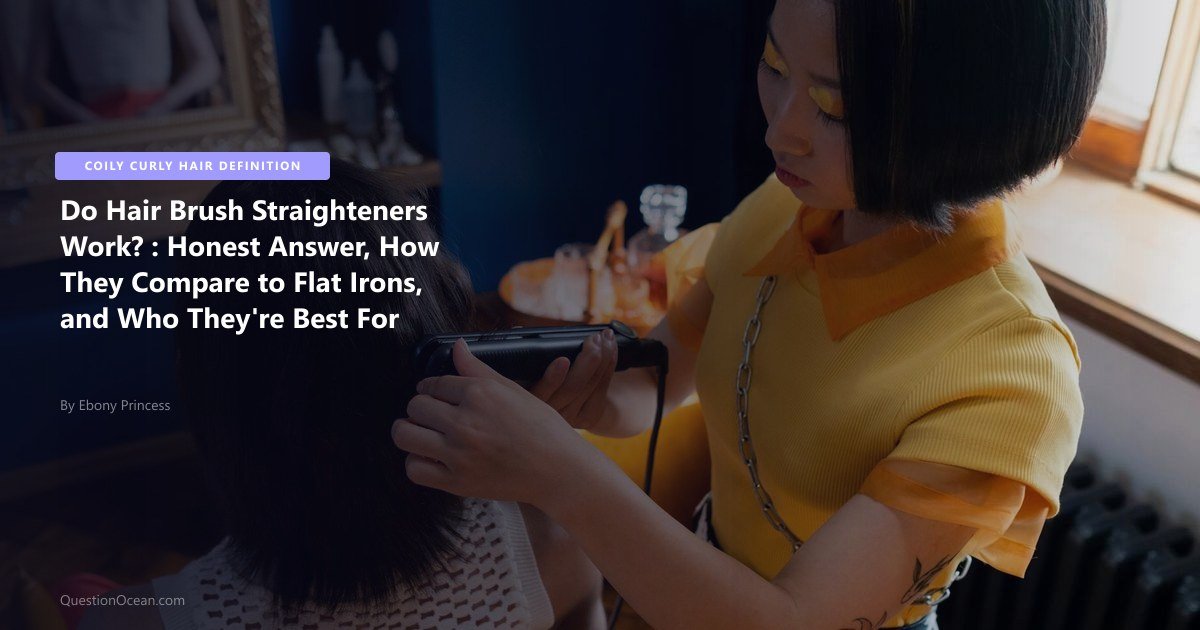
Quick answer: Yes, but with caveats. Hair brush straighteners (heated brushes) work well for smoothing out waves, reducing frizz, and adding sleekness to already-straight or slightly wavy hair. They do NOT work as well as flat irons for straightening curly or coily hair (Type 3-4). The brush format can’t clamp and heat hair from both sides simultaneously the way a flat iron does, so tight curls pass through without fully straightening. For Type 1-2B hair that wants a polished, smooth blowout look without the effort of a round brush and blow dryer, they’re genuinely useful.
How Brush Straighteners Work
Last updated: June 18, 2026
A brush straightener is a heated paddle-style or bristle-style brush. The bristles or plate surface heats up to 300-450°F. As you brush through your hair, the heat straightens the strand while the bristle format detangles and adds volume simultaneously.
The key difference from a flat iron: a flat iron clamps hair between two heated plates, applying heat AND pressure from both sides. A brush straightener only heats from one side (the bristle side). The other side of the hair strand has no heat contact. This means less total heat transfer per pass.
Why this matters: Less heat transfer means less straightening power. A flat iron at 350°F delivers more heat to the hair than a brush straightener at 350°F because the flat iron has double-sided contact. The brush compensates by having you make multiple passes, but each pass delivers less heat per stroke.
What They’re Good At
| Task | Performance |
|---|---|
| Smoothing straight to slightly wavy hair | Excellent |
| Reducing frizz on any texture | Good |
| Creating a blowout look without a round brush | Excellent |
| Adding volume while smoothing | Good |
| Quick touch-ups (5-10 minutes) | Excellent |
| Smoothing roots and hairline | Good |
| Taming flyaways | Excellent |
What They’re NOT Good At
| Task | Performance |
|---|---|
| Straightening Type 3 curls | Mediocre (reduces volume, doesn’t fully straighten) |
| Straightening Type 4 coils | Poor (barely changes the pattern) |
| Creating pin-straight, sleek results | Poor (leaves more texture than a flat iron) |
| Lasting results in high humidity | Below average (results revert faster than flat iron) |
Brush Straightener vs Flat Iron: Direct Comparison
| Factor | Brush Straightener | Flat Iron |
|---|---|---|
| Straightening power | Medium | High |
| Best for | Type 1-2B (smooth and polish) | Type 2C-4C (actual straightening) |
| Damage per session | Lower (single-sided heat, less direct) | Higher (double-sided heat, clamping pressure) |
| Speed | Faster on fine/straight hair | Faster on thick/curly hair |
| Volume | Adds volume (bristle format lifts roots) | Removes volume (flattens hair against plates) |
| Ease of use | Very easy (just brush) | Moderate (technique needed for smooth results) |
| Burn risk | Lower (bristles create a barrier between plate and skin) | Higher (exposed hot plates near face and ears) |
| Results on Type 2 | Good (smooth, polished, voluminous) | Overkill (too flat, removes natural body) |
| Results on Type 3 | Mediocre (reduces curl but doesn’t eliminate) | Good (can fully straighten) |
| Results on Type 4 | Poor | Good (with proper technique and multiple passes) |
| Price range | $25-80 | $20-250 |
The Honest Test: Results by Hair Type
Type 1 (Straight): Works perfectly. Smooths frizz, adds shine, creates a salon-quality blowout look in 5-10 minutes. This is the ideal user for a brush straightener.
Type 2A-2B (Loose waves): Works well. Relaxes waves into a smooth, straight-ish style with natural body and movement. Won’t get pin-straight, but most people with this texture don’t want pin-straight anyway.
Type 2C (Definite waves): Works partially. Loosens the wave pattern and reduces frizz, but you’ll still see some wave texture, especially in humid conditions. Expect a “wavy blowout” rather than straight hair.
Type 3A-3B (Curls): Struggles. Reduces the curl into a frizzy, undefined wave rather than smooth straight hair. Multiple passes don’t help much because the single-sided heat can’t overcome the curl’s spring force. A flat iron is necessary for this texture.
Type 3C-4C (Tight curls/coils): Doesn’t work for straightening. The brush bristles can’t get enough contact with tight coil patterns. Hair passes through without meaningful heat transfer. Use a blow dryer with a comb attachment first, then a flat iron.
3 Worth Buying
1. Revlon One-Step Hair Dryer & Styler ($30-45)
Not a pure straightener; it’s a hot air brush that dries AND smooths in one step. Works on wet hair, which saves time. Best for Type 1-2B hair that wants a quick blowout without separate tools. The oval barrel shape adds volume at the roots while smoothing the ends.
2. TYMO Ring Hair Straightening Brush ($35-50)
A dedicated heated brush (not a hot air brush). Heats to 450°F, has an anti-scald design with cool-tip bristles, and works on dry hair only. Better straightening power than most brush straighteners because of the higher temperature range. Best for Type 2A-2C hair.
3. Dafni Go Straightening Brush ($80-100)
Premium option with a ceramic heating plate behind the bristles. Claims to straighten in a single pass, which holds true for Type 1-2B but not for curlier textures. The ceramic plate provides more consistent heat than bristle-only designs. Best for travel (compact, lightweight).
Tips for Best Results
Start with dry hair. Unless you’re using a hot-air brush (like the Revlon One-Step), brush straighteners are designed for dry hair. Using them on wet hair causes steam damage and doesn’t straighten effectively.
Use a heat protectant. Even though brush straighteners deliver less heat per pass than flat irons, you’re still exposing hair to 300-450°F. A light heat protectant spray prevents cumulative damage.
Brush slowly. The most common mistake is brushing too fast. Slow, deliberate strokes (3-5 seconds per pass) give the heat time to work. Fast brushing moves the hair through before it absorbs enough heat to change shape.
Section thick hair. On thick or dense hair, working in sections (top layer clipped up, bottom layers first) ensures every strand gets heat contact. Trying to brush the entire mass at once leaves the inner layers untouched.
Don’t expect flat iron results. Set realistic expectations. A brush straightener gives “smooth and polished,” not “pin-straight.” If you need bone-straight results, use a flat iron.
Frequently Asked Questions
Q: Do brush straighteners actually work? A: Yes, for Type 1-2B hair that wants smoothing, frizz reduction, and a polished blowout look. No, for Type 3-4 hair that wants actual straightening. The single-sided heat format can’t straighten tight curls the way a flat iron can.
Q: Are brush straighteners less damaging than flat irons? A: Per session, yes. They deliver less total heat because only one side contacts the hair. They also don’t apply the clamping pressure that can crush the cuticle. Over time, though, if you make more passes with a brush to compensate, the damage gap narrows.
Q: Can I use a brush straightener on curly hair? A: You can, but the results won’t be straight. On Type 3 curls, expect reduced volume and a wavy (not straight) result. On Type 4 coils, expect minimal change. For curly hair that wants straight results, a flat iron after blow-drying is the reliable approach.
Q: How long do brush straightener results last? A: On straight to wavy hair, results last 1-2 days (until the next wash or high-humidity exposure). On curlier textures, the partial smoothing may revert within hours, especially in humidity.
Brush straighteners are a legitimate tool for the right user. If you have straight-to-wavy hair and want a fast, easy way to polish and smooth without the learning curve of a round brush blowout, they deliver. If you have curly or coily hair and want actual straightening, save your money and use a flat iron.
For more on heat styling and curl recovery, see our curl recovery guide.